
The Shifting Ideal:

Workplace Personality Traits in the Age of AI

For decades, organizations have relied on psychometric inventories to define, measure, and select for an “ideal” workplace personality. Traits like conscientiousness, extraversion, and emotional stability have been repeatedly linked to job performance, leadership emergence, and career success.

But the rise of artificial intelligence (AI)—especially systems that automate analytical, repetitive, and even creative tasks—is beginning to reshape not just what work gets done, but how humans add value at work.

This raises a critical question for employers and talent leaders: as AI changes the nature of work, will the personality traits we value most also change?

What AI Changes: From Execution to Judgment

AI adoption does not eliminate roles overnight. Instead, it reconfigures task bundles within roles. Tasks that are repetitive, rule-based, data-heavy, and optimisation-focused are increasingly automated or augmented by AI systems.

As a result, human effort shifts toward areas where judgment, interpretation, and coordination matter more than execution alone.

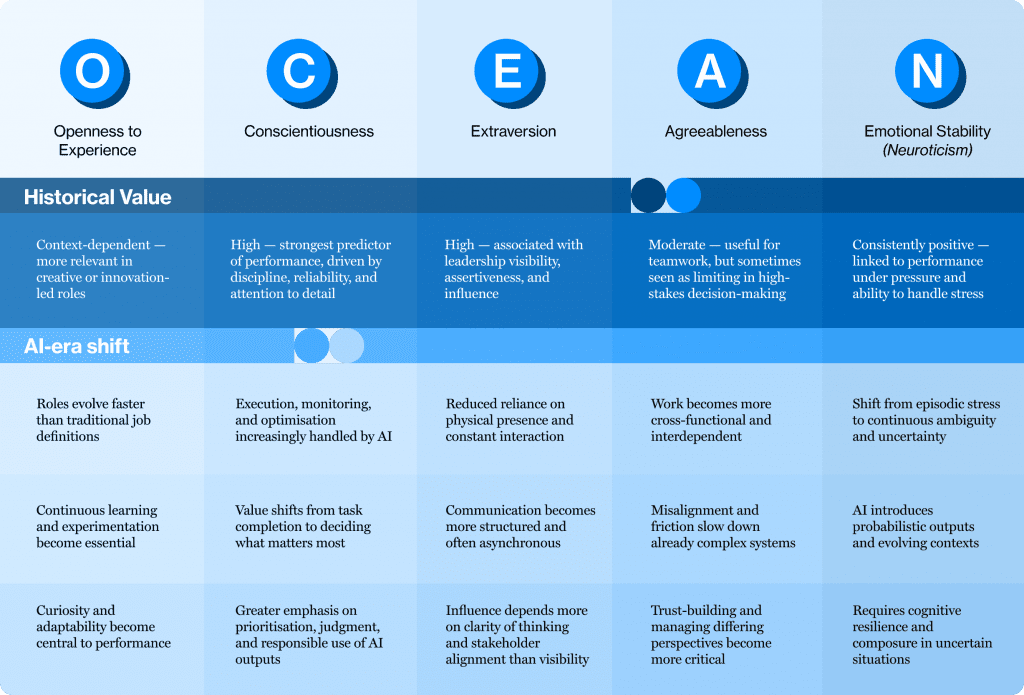
This redistribution of work has important implications for personality–performance relationships. Traits that were valuable because they supported execution and consistency may decline in relative importance, while traits linked to adaptability, learning, and collaboration may rise.

How Personality Value
Is Shiftin

Beyond the Big Five: Expanding the Lens

Traditional personality frameworks may underweight traits that are becoming more relevant in AImediated work. These include learning orientation, metacognitive awareness, ethical sensitivity, and systems thinking.


In other words, understanding personality at work may need to move beyond static trait definitions toward a more dynamic view of how individuals learn, adapt, and make decisions in evolving environments.

Decoding Behavioural Readiness for AI

We reviewed personality data of managers from 15 BSE100 organisations to review broader readiness for driving the AI agenda.

Interpretation

Today, managers are well-equipped to drive outcomes when it is well-def ined. But only few are inclined to push beyond norms and fully leverage a new technology to lead transformation. Identifying and developing these leaders as AI champions becomes a critical priority for organizations. As the AI agenda trickles downward, organizations also need to equip managers with skills to lead their teams navigate through the change cycle.
With targeted behavioural interventions to bridge these gaps, India inc. can move towards a more sustained and scalable AI-led transformation.

Closing Note

AI ambition in Indian organisations is supported by capable and driven managers, but as the nature of work evolves, so must the behavioural pro f ile required to lead it.
Instruments like the Think Talent Personality Inventory (TTPI) help organisations decode these behavioural patterns, enabling them to build leadership capability aligned to the demands of an AI Age