
From Skill Silos to Role-Based Capability Design
For years, talent development has been organized around distinct skill buckets—communication, analysis, leadership—each developed and assessed separately. While this approach created structure, it fragmented the way work truly happens.
Now, organizations are questioning if skill-based design can fully capture the complexities of real-world roles.
Modern roles, especially in leadership and client-facing positions, require a constant mix of technical knowledge, behavioral maturity, and judgment.
People often face high-pressure decisions, competing priorities, and cross-boundary influence in the same day. Yet many learning journeys treat skills as standalone, ignoring their integration in real-life roles.
The truth is, people perform roles, not isolated skills.

Skill-based models assume that once someone learns a skill, they can apply it across situations. However, transfer is not automatic.
A manager may know feedback models but hesitate in a high-pressure, politically sensitive situation. The gap isn’t knowledge; it’s applying the skill within the complexity of the role.
Clients are noticing that gaps aren’t due to missing skills, but unclear expectations of what “good” looks like in a specific role. Without this context, skills remain theoretical, and learning investments don’t translate into consistent performance.

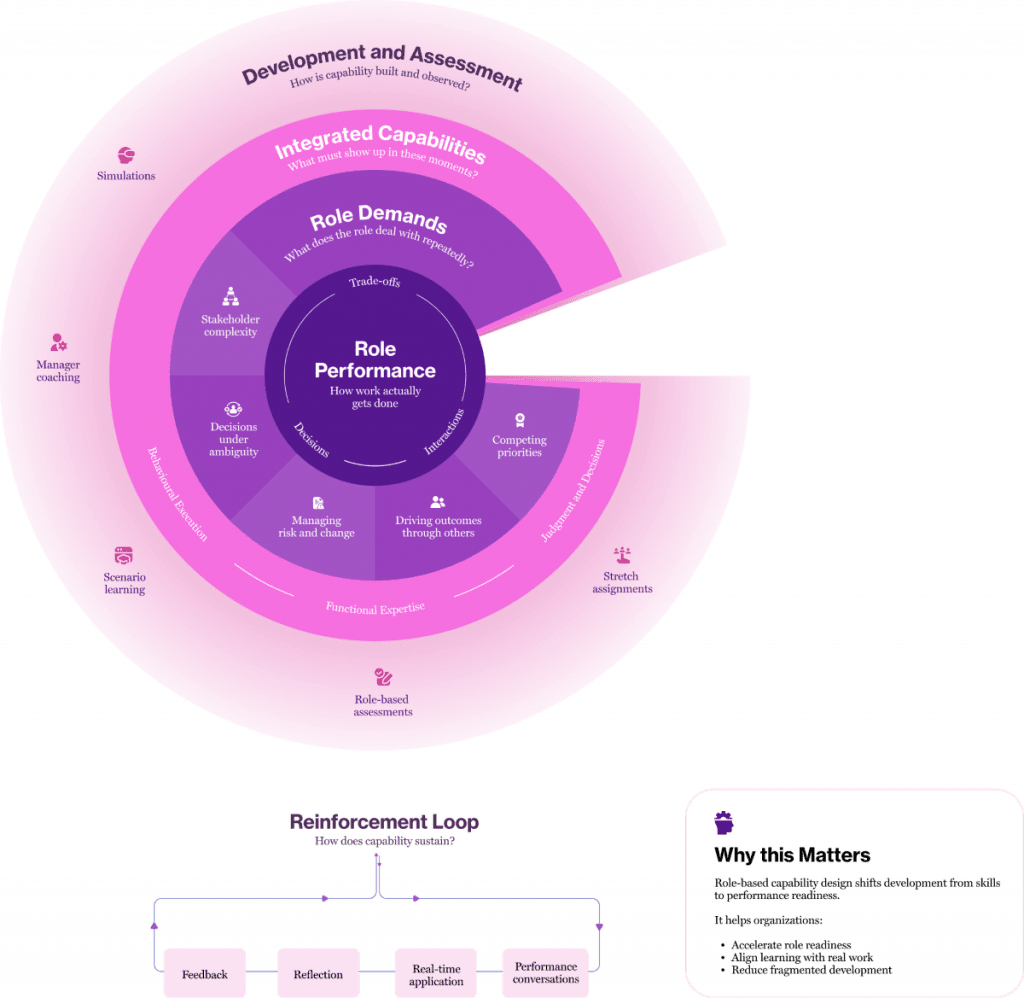
Role-based learning and assessment are anchored in real work moments—performance discussions, client negotiations, and operational crises. Participants engage with situations that mirror their own challenges. Functional and behavioral capabilities are developed together, reflecting the role’s demands.
Assessment focuses on how individuals respond to role scenarios, navigate ambiguity, and make trade-offs.
Role scenarios

This alignment helps managers understand expectations clearly, as learning mirrors daily work.
Role-based design addresses common business pain points. It accelerates transitions into new roles by clearly defining success criteria. It drives performance consistency by aligning people with shared expectations of their role, not just a list of skills. It also improves the link between learning investments and business outcomes.
By focusing on role-specific needs, it reduces cognitive load, offering participants a coherent view of how their role demands different capabilities.

For L&D leaders, the challenge is moving from skill-based frameworks to role-centric learning experiences that mirror real work.
info@thinktalentindia.com
+91-9910955257
+91-8828158509