

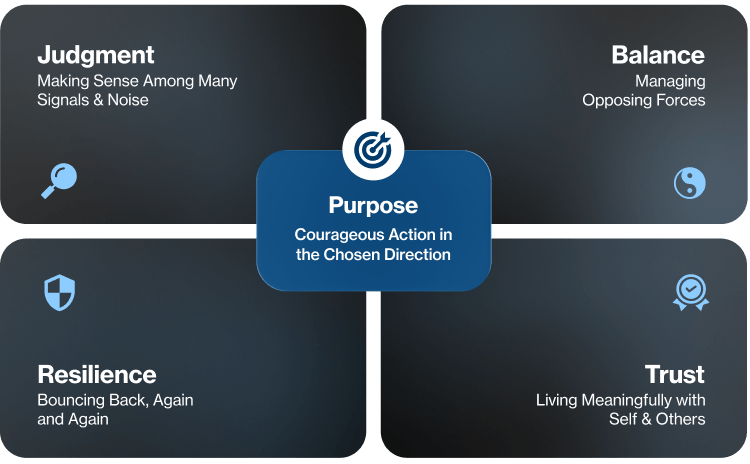
In an age of AI, leaders are surrounded by more data, more dashboards, and more recommendations than ever before. Paradoxically, this has made judgment—not certainty—more valuable.
CXOs spoke about the need to sense patterns rather than chase precision. AI can surface correlations and probabilities, but it cannot fully grasp context, ethics, or long-term consequence. Leaders are increasingly required to decide under conditions where answers are incomplete, timelines are compressed, and outcomes matter deeply.
Judgment in this environment is not about having all the facts; it is about asking the right questions:

Almost every CXO described leadership today as a constant act of balance.
On one side is speed—AI enables rapid experimentation, automation, and execution. On the other is deliberation—ensuring that decisions are ethical, inclusive, and sustainable. Leaders must balance technology adoption with human impact, efficiency with empathy, and short-term performance with long-term capability building and sustainability.This balance is not static.
It shifts across moments:
Centralization vs. empowerment
Innovation vs. operational stability

If AI is accelerating change, it is also increasing volatility.
Strategies evolve faster. Skills become obsolete sooner. Mistakes are more visible—and sometimes more costly.
In this context, resilience emerged as a critical mindset rather than a one-time response to crisis. CXOs spoke about the ability to recover quickly from setbacks, unlearn outdated assumptions, and keep moving without becoming defensive or cynical.


The leader’s personal ability to experiment and fail, and learn and be public about the failures, can be a key strength. In organizations learning to work alongside AI, failure is inevitable. Resilient leaders normalize learning loops rather than blame cycles.
Perhaps the most repeated theme was trust.
As AI systems influence hiring, performance evaluation, and strategic decisions, trust becomes both more fragile and more essential. Leaders must navigate multiple layers of vulnerability: their own dependence on technology, employees’ fears of replacement, and stakeholders’ concerns around fairness and transparency.
Trust, the CXOs noted, is built through:
Across all four themes, a common insight emerged:
AI will continue to evolve rapidly, but leadership success will hinge on human strengths that technology cannot replicate.
The age of AI does not diminish the role of leaders—it raises the bar. The leaders who will succeed are those who combine technological fluency with emotional intelligence, clarity of thought with humility, and speed with wisdom.
info@thinktalentindia.com
+91-9910955257
+91-8828158509