





The four shifts driving the urgency:
The role of the manager has fundamentally changed. Most managers have not caught up.
The
four shifts driving the urgency:
Interpreting context accurately to respond with the right approach — diagnosing skill vs. will, context vs. behaviour, before acting.
Driving clarity, ownership, and action through structured dialogue — not compliance.
Turning everyday work into moments of capability building — the discipline to know when to step in and step back.
Built to be learned, practiced, and lived.
Read the moment before you respond. Recognise when coaching adds value. Tell apart coaching, mentoring, and managing. Pick the right move: Tell, Guide, or Coach.
Manage yourself before you manage the conversation. Notice assumptions, biases, and triggers. Slow down enough to be curious. Build safety where people say what they really think.
Make the conversation do the work. Move from confusion to clarity in four moves. Listen to understand. Question to expand. Reframe to shift the angle.
Get better, deliberately. Practice in front of peers and a facilitator. Watch yourself coach on video. See where you go on autopilot. Techniques that fit a 10-minute hallway conversation.
Make it stick beyond the program. Walk out with a personal playbook. Sign a 90-day coaching commitment. Anchor the change to real work, not the side of the desk.
Five connected stages that take a manager from baseline to lasting shift.
The journey begins with where each manager and the cohort stand today.
Coaching Skill Assessment, 360° Feedback, and a Group Insight Report set the baseline.
The data is pulled up in sessions for collective actioning.
Immersive, in-person and virtual sessions grounded in the participant's real world of work.
Small groups, peer dialogue, established and contemporary frameworks.
Participants learn by doing — turning the room into a practice ground.
What gets practiced in the room gets used on the job.
AI-driven coaching simulations. Real-time feedback on screen.
Situational Judgement scenarios across the full employee lifecycle.
Practice repeated for behavioural changes.
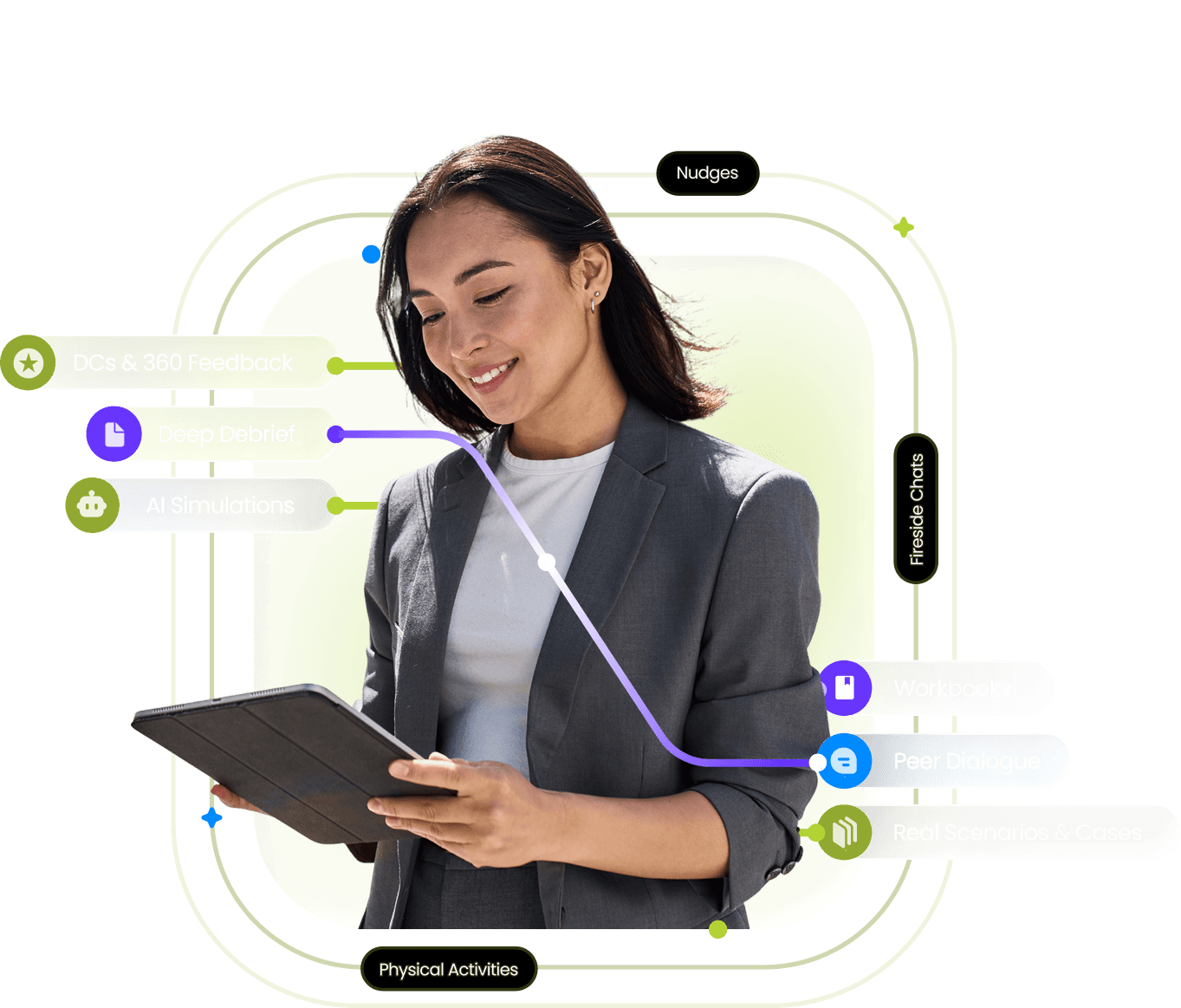
Workbooks, nudges, video scenarios, fireside chats, and curated reading. Six months of access post-program. Alumni network for continued peer learning. Platform-enabled tracking, leaderboards, and gamification.
The Business Need – Every new property meant new teams, new pressure, new ways things could go wrong. The growth plan depended on one quiet question — could their functional leaders develop people fast enough to keep up?

The Business Need – Years of being right made these leaders fast, sharp, decisive — and quietly closed to ideas that weren’t theirs. Manager-as-a-Coach was the unlock for innovation at scale.
info@thinktalentindia.com
+91-9910955257
+91-8828158509