

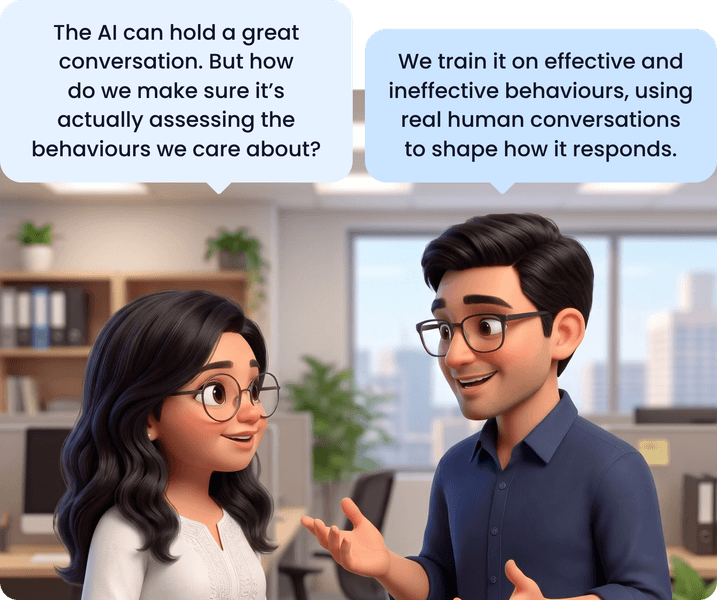
A realistic conversation doesn't automatically make a rigorous assessment.
We start by defining the effective and ineffective behaviours relevant to the assessment. We then use real-life human conversations to train the AI on how different behaviours may emerge and how it should respond within the scenario.
This helps the AI move beyond simply maintaining a conversation to creating meaningful opportunities for participants to demonstrate the behaviours being assessed.
Rigour starts with behavioural design. The AI must be trained to recognise and respond to relevant behaviours, not just sustain a natural conversation.
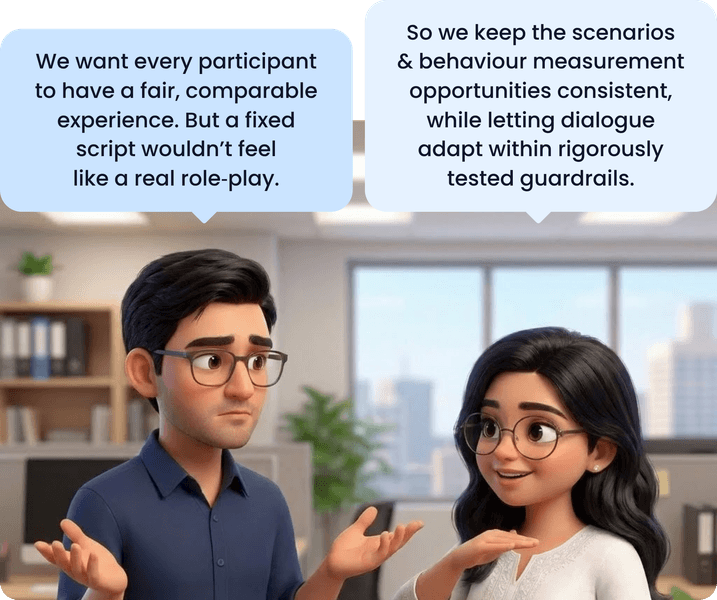
Standardisation supports fairness, but overly scripted interactions can compromise realism.
Our approach is to standardise the scenario, behaviour measurement opportunities and assessment criteria, while allowing conversations to adapt to individual responses within defined guardrails.
We rigorously test different participant response patterns to check whether the AI remains in character, respects conversational boundaries and provides comparable opportunities to demonstrate the target behaviours.
Standardisation shouldn't mean identical conversations. It should mean comparable assessment conditions, with enough flexibility to reflect real-world interactions.
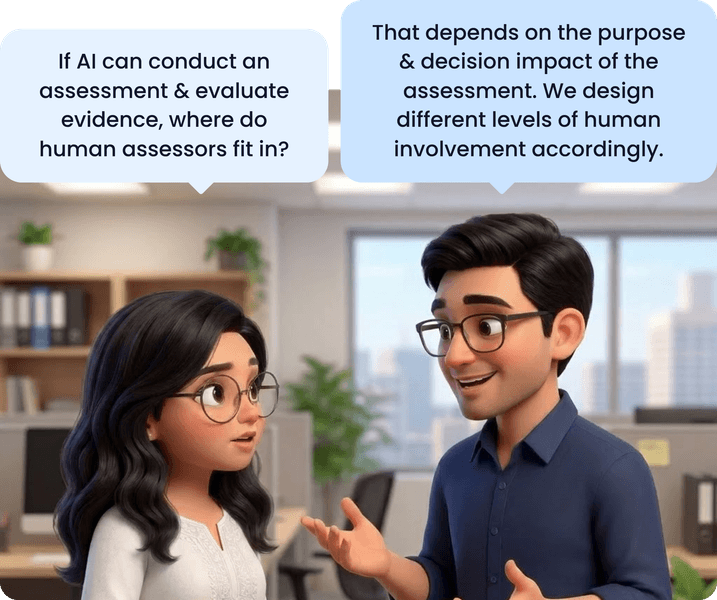
Human involvement in AI-led assessments isn't an either-or decision.
Depending on the assessment's purpose and decision impact, we use different approaches: human-led evaluation, AI-assisted evaluation, risk-based human oversight or AI/logic-based insights.
For some assessments, trained assessors evaluate the behavioural evidence captured through AI interactions. In others, AI supports evaluation or generates structured insights, with oversight designed around the significance of the decision.
There is no single model of human involvement. The objective is to determine where human judgement is necessary and where technology can reliably support the process.
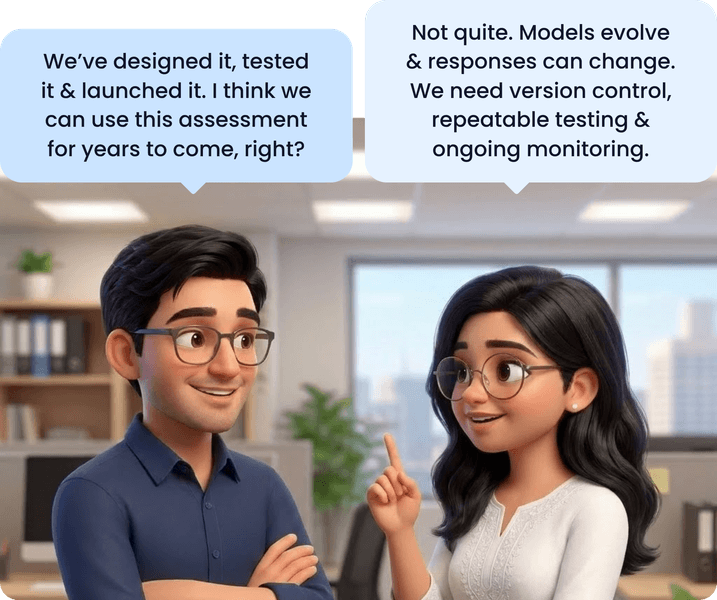
Unlike conventional rule-based software, AI models can produce variable responses. Even small changes to models, prompts or configurations may influence how an assessment unfolds.
Our approach includes version control, regression testing and exception monitoring to identify unexpected behaviour, inconsistencies and deviations from the intended assessment experience.
This makes testing an ongoing responsibility rather than a one-time activity before launch.
AI assessments cannot be treated as static software. Continuous testing and monitoring are essential to maintaining reliability as the underlying technology evolves.
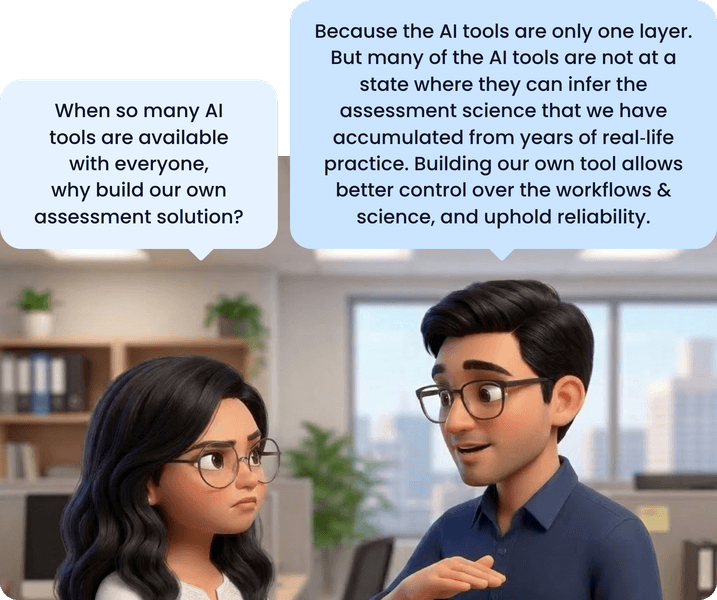
Powerful AI tools are readily available, but a conversational model alone doesn't make a scientifically grounded assessment.
Our approach combines existing AI capabilities with our own assessment design expertise and technology layers. This allows us to retain control over behavioural logic, interaction design, assessment workflows and reliability.
Rather than building everything from scratch, we focus on developing the layers where assessment expertise, customisation and control matter most.
The choice isn't simply between building and buying. It's about using existing technology while retaining ownership of the assessment science and processes that make the solution credible.
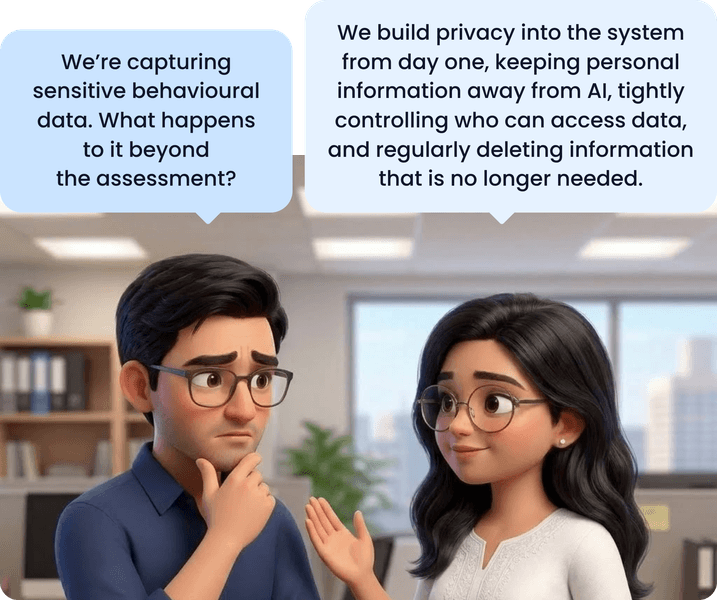
AI assessments involve sensitive participant information, making privacy and data governance fundamental design requirements.
Our architecture separates personally identifiable information from AI interactions, ensuring it is never shared with AI. Defined access controls and audit trails support accountability, while strict data-purging practices ensure information is retained only as long as necessary.
These controls are embedded into the system from the outset rather than added as a separate compliance layer.
Data privacy and governance are product design decisions. Protecting participant information requires deliberate choices about architecture, access, auditability and retention.