

AI is opening new possibilities for how we assess, develop and understand talent.
At Think Talent, we are building AI into our assessments to make them more realistic and more scalable, while keeping assessment quality, human judgement and responsible use at the centre.
AI character
Thinking…Speaking…Listening…
Tell me about a conversation that didn't go the way you planned.
Participants step into a live conversation with a character that reacts to what they actually say, instead of choosing from options on a screen.
The same conversation for every participant, at any hour. Hundreds of people can be observed as consistently as ten, and patterns across a whole cohort become visible.
Every exercise is designed against your competency framework, and trained assessors evaluate every transcript. AI runs the conversation. People make the judgement.
Participants handle a challenging conversation with an AI character that holds its brief and its mood. It warms when its concern is heard and hardens when it is brushed past.
Runs by chat, in English.
Talk to us about DialogueBrief
Fixed script, for illustration. Nothing here is recorded.
An AI interviewer asks your questions and probes until each answer is complete: a behavioural event interview, a competency-based interview or your own format. Participants speak naturally and review the transcription before it is sent.
Illustration. Names are invented.
Talk to us about AI InteractionAI character
Listening…Thinking…Speaking…
Every scenario and interview template is built by Think Talent's assessment team around your roles and competencies, down to the character's name.
Every manager met the same difficult moment, and every word they said is in the transcript. Not a sample seen by a panel: the whole group, in its own words.
Engagement
96%
of 112 managers held a real conversation (three or more exchanges), with no one supervising. The median ran 23 minutes and 458 words, and 14% started between midnight and 6am.
Behaviour
54%
did not acknowledge a failure of their own; 46% did. A panel sees a handful of managers a day. Here, ownership was observed across the whole cohort, in each manager's own words.
Managers opened by asking: one message in four was a question. By the close, almost none were. Listening gave way to solving.
In 53 of 112 conversations the character warmed to the manager, usually by the seventh exchange. In 15 it turned cold, usually by the fourth: a conversation that fails does so before the manager has finished making their case. The rest held steady.
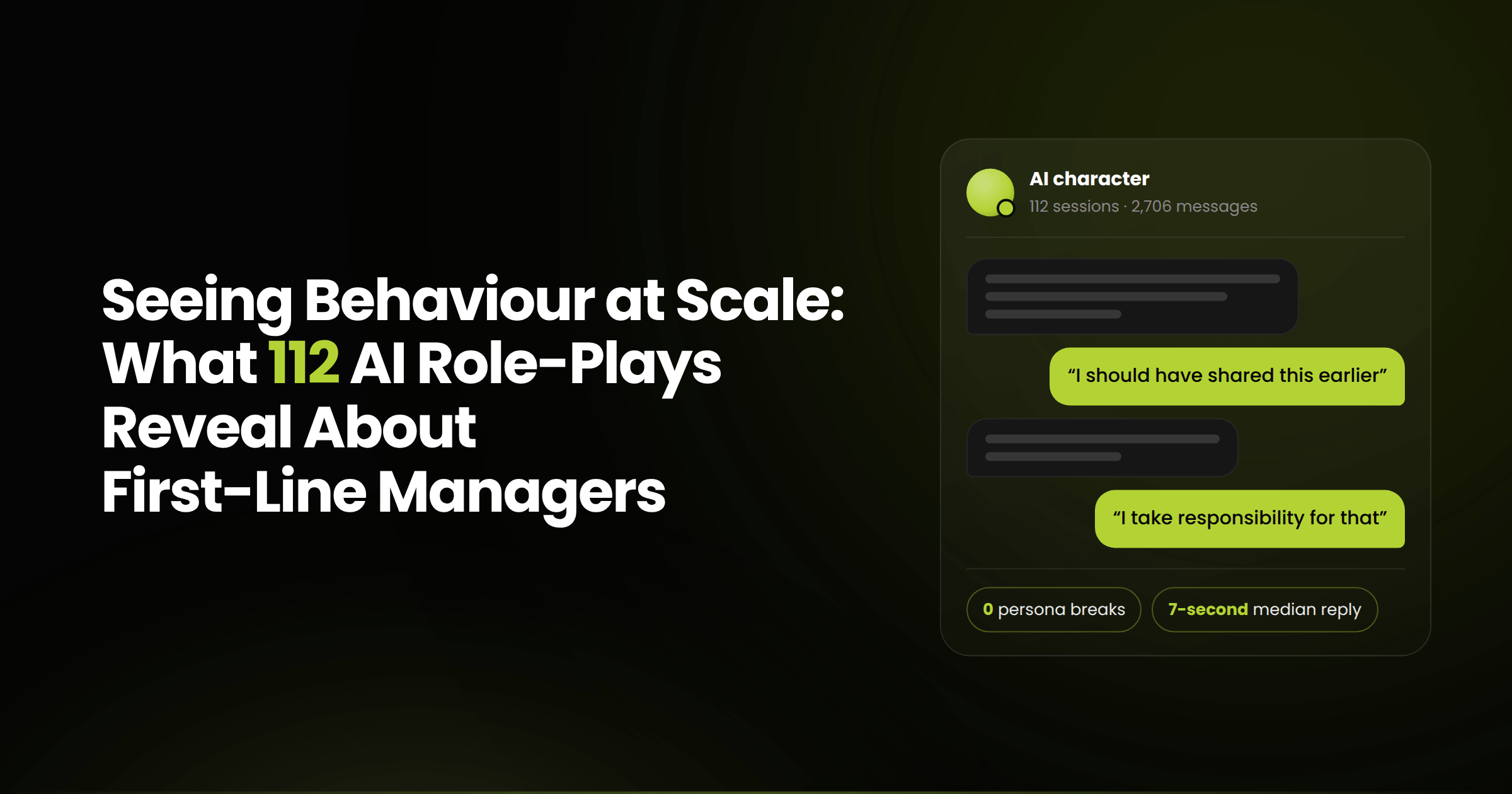
Across 1,353 messages the character held its role and its brief every time, replying in a median of 7 seconds.
Where validation stands. These markers come from language analysis of every transcript, read the same way for every manager. The next stage checks that reading against trained assessor ratings, then against on-the-job performance, and we publish each result as it lands.
Using AI in assessment takes more than getting the technology to work. These are the questions we hold our own work to, and how we answer each one today.
Are we measuring what we intend to measure?
Your framework defines what good looks like. The AI gathers the evidence.
Every scenario and interview is designed by our assessment team against your competency framework, with the same discipline as our development-centre exercises. Next in validation: agreement between AI-derived measures and trained assessor ratings, published as it lands.
Can we generate dependable, comparable evidence?
Same character, same brief, same questions, for every participant.
Rules decide the character's next move, and its lines come from a library written for it. Across 1,353 messages in 112 unsupervised conversations, it never broke role, replying in a median of 7 seconds.
Where should AI support the process, and where should people stay responsible?
The AI never scores anyone.
AI runs the conversation and produces the transcript. Trained assessors evaluate it and make every judgement about a participant.
How do we address bias, accessibility and data protection?
No language model ever sees who a participant is.
Names, emails and employee IDs are replaced with pseudonyms before any model sees a message. Data is encrypted at rest and in transit, never used to train anyone else's model, and kept on the terms of your agreement, in line with India's DPDP Act, 2023. Participants can speak or type, and review each answer before it is sent.
Read our privacy noticeAI does
People do
Whether you are looking to scale assessments, create richer simulations or understand the implications of AI for your talent strategy, let's explore what is possible.
AI characterMayaAmarArjunYour character
info@thinktalentindia.com
+91-9910955257
+91-8828158509